about vartaphalaks...

the ubiquitous vartaphalaks which dot the older parts of pune city in hundreds, represent a fascinating case of public spaces which become sites of articulation of different kinds of agendas and identities, in an urban context. vartaphalaks generally serve as visual markers of the collective that exists in the precincts of that notice board. this could be local branches of political parties, youth collectives, residential collectives, auto rickshaw drivers’ unions and so on. the various symbols and imagery that is inscribed in and around these spaces and the content and the rhetoric of the matter written on vartaphalaks make for a public space extremely rich in visual content.

spaces around vartaphalak

spaces around vartaphalak
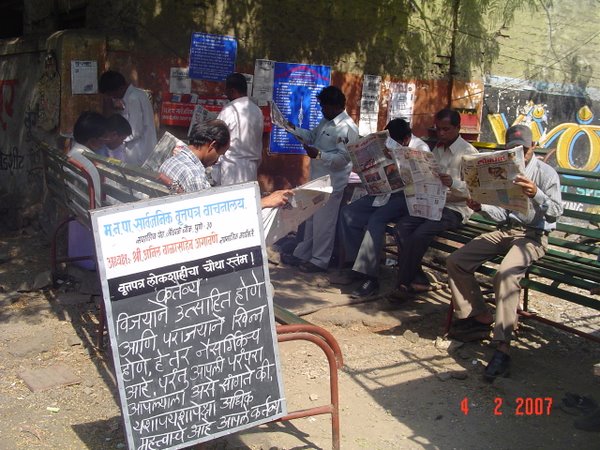
kumthekar road, sadashiv peth
this is a typical space as defined by a vartaphalak. this message was written a day after the civic election results were declared, expounding on the topic of 'kartavya': It is but natural to be enthused by victory and be disappointed by defeat. However our tradition tells us that more important than victory or defeat is our duty

spaces around vartaphalaks

spaces around vartaphalaks
tiranga young circle vartaphalak, ghorpade peth

Friday, June 22, 2007

Post # 4 contd...Kachi Aali...


Evening times in Kaachi Aali. One can hear both the aazan as well as the church bells tolling here. This flock of sheep returns home around the same time in the evening, completely occupying the narrow Aali and causing a traffic jam of sorts. A herd of buffaloes also traverses to and fro from their shed down the road. It is only later in the evening that Shahid and his friends gather here, after returning from work.


Post # 4 contd...neighbourhood around the vartaphalak


This is Maashi Aali. The lane gets its name from the fish market that is held here everyday. This is located in a couple of lanes parallel to Kachi Aali, and officially comes in the adjoining area, Mahatma Phule Peth. The congested alley is basically a fish- cum-vegetable-cum-everything-else market, flanked by Dalit basti on one side and Ghorpade Peth on the other.

Post # 4 contd...neighbourhood...


This cinema parlor (above) is located right on the periphery of a Dalit slum adjoining Maashi Aali. It was a surprise as I thought cinema parlors had disappeared from the city at least. I also discovered another such parlor in Shukrawar Peth during another of my trips.
Another vartaphalak (below) located in the Dalit slum. A message wishing people on the occasion of the 2550th birth anniversary of Lord Buddha.

Post # 4 contd..Kachi Aali again...


These photographs were taken around 8 in the morning. As I walked down the Kachi Aali, I was struck by one activity that all the women in the Aali as if collectively engaged in…washing clothes and utensils. Small rivulets of water originated at regular intervals along the Aali, as almost every household had a woman sitting in front of the door with piles of washed and wrung clothes and utensils. Water supply must be lasting till about 9.30 or so in the morning here after which there was probably no chance of water supply being resumed till late in the evening.

It might almost sound comic but another thing that struck me about the landscape of Kachi Aali was the presence of a variety of animals there. I passed baskets of eel-like fish kept in water (probably to be taken to sell in Maashi Aali next door), cows tied in a shed amidst overwhelming smell of cow dung, hens scampering about in the middle of the road, clucking as if panic-stricken. In the lane where Tiranga Young Circle is located, a make-shift stable had been constructed for a couple of horses, who probably belonged to a wedding contractor. The shiny Victoria-like carriage stood outside, blocking half the road.

Post # 4 contd...Urus at the Durgah


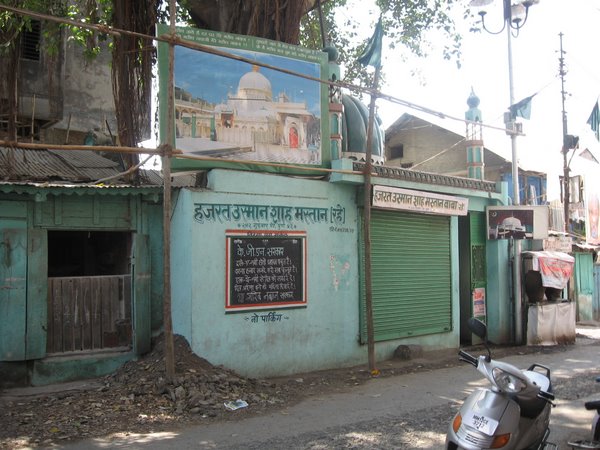
This was a special day for Siddi Shah Moula Durgah. It was the occasion of the Urus and Sandal Sharif in the honour of the pir. There was great hustle and bustle around the entire space when I had landed there a day before the festival. The entire Siddi Shah Moula Durgah committee was busy running around making arrangements. On the day of the Urus, the place had been transformed completely. Green flags, mandap decoration lined the roads. The small durgah was also elaborately decorated with flowers , a new metal ghumat was affixed atop the cement structure to give it an authentic durgah look. Massive loudspeakers were stacked up on one side of the road, in readiness to blare out qwaalis at deafening decibels. Children played frenziedly and my presence there with a camera made their frenzy climb a notch higher.

As the prayers began to be recited by the Moulana, some women (including Shahid’s proud mother, sister and aunt) joined me to watch the ceremony from outside. The 30 minute long prayer was followed by an absolutely mesmerizing performance by the dhol-tasha (drums) party specially invited to play for this occasion.

Post # 4 contd...Urus...


A bhandara (community meal) was organized on the next evening. Shahid was looking dapper in his spotless white kurta and a green coloured silk fez. It was clear that he was the host for the function, running around, shouting directions for food to be served, welcoming the elders and making sure that they were comfortable. The road in front of the vartaphalak was occupied by small groups of men sitting to share the meal. This lane is closed to traffic for 4 hours for the bhandara. Volunteers carried buckets filled with daal and huge degchis of rice rushing to serve the different groups. The menu was vegetarian, since according to Shahid, the people from the entire Kachi Aali come to partake of the pir’s prashaad on this day. I was directed to a separate place where all the women folk were served.

Post # 4 contd...a chat with mohallawallahs


I had a chance to chat with the entire group of the committee members, people staying in the neighbourhood to talk about my study and what they thought about it. Referring to the content of the vartaphalak they said that they always stayed away from anything that was remotely political. They wanted nothing to do with it. Their only concern was to convey good thoughts to people. And they categorically stayed away from a political agenda. I also asked them about the anti-Muslim boards. Ayaz, the committee’s chairman, was a rickshaw driver and he instantly pointed out the board near Lokhande Taalim and said that that was a really aggressive one and it was meant to incite people (bhadkaane ke liye).

Ayaz Sheikh also mentioned that women, when they passed the vartaphalak could also get an opportunity to read some religious matter. He said that in their community women were not given much education and hence through this vartaphalak they could at least read some good thoughts. At the same time he admitted that attitudes in the community towards women sitting out in public were conservative, making it impossible to occupy such spaces.

There was also a lot of talk about the unity in their mohalla. But they said that even when there are riots, their area is never affected. They all stay together. Everybody helps each other. They also told me about the time when a lot of thefts were happening in the neighbourhood. The boys used to patrol in the nights till they caught the culprits and handed him over to the police. Even for the Urus, Shahid had mentioned that they did not take any vargani (contributions) from the people. The entire mohalla contributed towards the effort by contributing in kind; giving foodgrains and other necessary material. Shahid’s uncle had provided all the electrical equipment for both the days of the festival.